Twenty-Two Minutes: Entropy, Uncertainty and the Decision That Cannot Wait
What a quiet patient in the emergency department taught me about Schrödinger, uncertainty and why some mistakes cost far more than others.
A quiet patient
Some years ago, early in the morning, I was asked to see a woman in her forties in the emergency department. She was previously healthy, had no known illnesses and was sitting quietly on the examination couch. She was not screaming, but her face showed severe pain, and she told me the pain was very strong. Her only complaint was pain in the upper abdomen that had started suddenly about twenty minutes earlier. A nurse had already given her an intravenous painkiller (metamizole) before I arrived — it had barely helped.
The history gave me almost nothing. No vomiting, no unusual food, no fever. The physical examination gave me even less: a soft abdomen, no tenderness that matched the expression of pain on her face.
I placed the ultrasound probe on her abdomen, as I always do. At the origin of the superior mesenteric artery — the vessel that supplies most of the small intestine — I saw something faint and “smoky”, barely visible on an old machine. I put on my glasses to be sure it was not an artefact. The nurse next to me saw nothing unusual.
Twenty-two minutes had passed since the pain began. I had a tiny, uncertain signal — and a decision to make.
Life as an island of order
In 1944, the physicist Erwin Schrödinger asked a simple question in his book What Is Life?: how can living organisms maintain order in a universe that tends towards disorder?
His answer: life survives only by continuously taking in energy and exporting disorder to its surroundings. Without this constant flow, the natural direction of every system is towards decay — towards higher entropy.
Medicine sees this every day. Homeostasis is not a resting state; it is continuous work. Ion pumps, the heart, the kidneys and the liver work without pause to keep us ordered.
The intestine is a striking example. It is highly active tissue with a large energy demand. When its blood supply stops, order begins to collapse within hours. The result is ischaemia, then necrosis — and necrosis cannot be reversed.
This is the first lesson: doing nothing is not neutral. Without action, the body drifts towards irreversible damage.
Uncertainty can be measured
Four years after Schrödinger’s book, the engineer Claude Shannon gave entropy a second meaning. In information theory, entropy measures uncertainty: how much we still do not know.
At the start of every consultation, uncertainty is high. Each question, each examination and each test should reduce it.
In my patient, the usual sources of information failed. The history was unremarkable. The examination was almost normal. The only information was a faint shadow on the ultrasound that another person could not even see. The uncertainty remained very high.
Where the asymmetry decides
This is the moment where many decisions go wrong — because we ask only one question: “What is most likely?”
Statistically, a healthy woman in her forties with epigastric pain most likely has something harmless. But in an emergency department the second question matters more: “What would be most dangerous to miss?”
Consider the two possible mistakes:
- If I order a CT angiography and I am wrong: a little contrast medium, some radiation, some cost — and, as it turned out, a colleague who bet me pizza that I was imagining things.
- If I do not order it and I am wrong: a young, healthy patient may lose large parts of her intestine, or her life. Acute mesenteric ischaemia still has a high mortality, largely because it is diagnosed too late.
The two errors are not symmetric. One is small and reversible; the other is catastrophic and irreversible. When the consequences are this unequal, even a small probability justifies action.
Decision science describes exactly this with the threshold approach: the more serious a missed diagnosis and the safer the test, the lower the probability at which we should test.
There was also a classic warning sign, which I recognised only afterwards in words: severe pain with an almost normal examination — “pain out of proportion to findings”. It is one of the typical early clues of acute mesenteric ischaemia.
The result
I ordered an emergency CT angiography. About twenty minutes later, the radiologist called: a very early thrombus at the origin of the superior mesenteric artery. The patient went straight to surgery, the operation took many hours — and she survived. The case was later published as a case report.
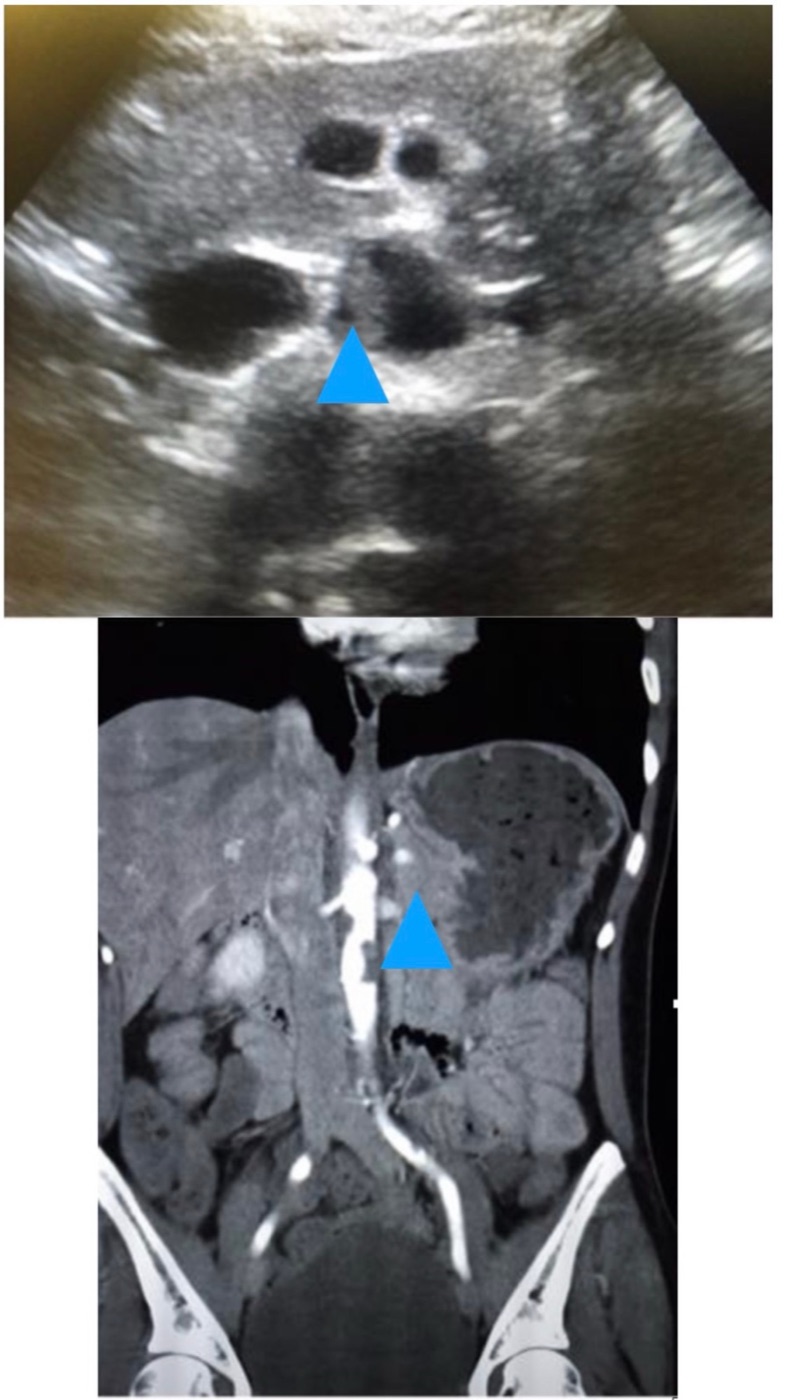 Ultrasound and CT scan. Top: abdominal ultrasound. Bottom: CT angiography of the abdomen. The blue arrows mark the thrombus in the superior mesenteric artery.
At the time, I could not explain how I reached the diagnosis. Something simply told me that I must not wait.
Looking back, I believe that “whisper” was not luck. It was experience compressed into a few seconds: recognising, before I could put it into words, that the uncertainty was high and the possible harm was irreversible.
The most important lesson
My decision would have been right even if the CT had been normal.
A good decision under uncertainty is judged by the reasoning at the moment it is made, not only by the outcome. Had the scan been negative, I would have paid for the pizza — and I would order the same CT again tomorrow.
Beyond the emergency department
The connection between Schrödinger and Shannon reaches far beyond medicine:
- Entropy makes damage easy and repair hard. Health, knowledge, relationships and institutions decay unless they are maintained.
- Under uncertainty, protect first against what cannot be undone. Prevention, early action and “rule out the worst first” all follow from the same logic.
- Do not confuse “most likely” with “safe to ignore”. The rare, irreversible case deserves more weight than its probability alone suggests.
Life is a constant struggle against entropy. Good medicine — and good thinking — means making asymmetric decisions in that struggle, before the arrow of time decides for us.
When the cost of acting is small and the cost of waiting is irreversible, uncertainty is not a reason to wait. It is a reason to act.
What is entropy? A simple explanation
Entropy is a measure of how much disorder or randomness there is in a system.
An everyday example: a tidy room becomes messy over time without anyone making an effort, but tidying it again takes work and energy. A glass shatters in a moment, yet it never reassembles by itself. The reason is that there are far more ways to be disordered than to be ordered.
The physical law: the second law of thermodynamics states that in an isolated system, entropy tends to increase over time. This is why time has a direction — from order towards disorder — often called “the arrow of time”.
And living organisms? A living body is not an isolated system. It constantly takes in energy from food and oxygen, uses it to maintain its internal order, and releases heat and waste into its surroundings. When this energy supply stops in an organ — as when an artery is blocked — disorder wins quickly.
In information (Shannon): entropy means the amount of uncertainty — how much we do not yet know. At the start of a patient examination, entropy is high, and every question, examination or test should reduce it step by step.
References
- Schrödinger E. What Is Life? The Physical Aspect of the Living Cell. Cambridge University Press; 1944.
- Shannon CE. A mathematical theory of communication. Bell Syst Tech J. 1948;27:379–423, 623–656.
- Pauker SG, Kassirer JP. The threshold approach to clinical decision making. N Engl J Med. 1980;302(20):1109–1117.
- Clair DG, Beach JM. Mesenteric ischemia. N Engl J Med. 2016;374(10):959–968.
- Björck M, et al. Management of the diseases of mesenteric arteries and veins: clinical practice guidelines of the European Society for Vascular Surgery (ESVS). Eur J Vasc Endovasc Surg. 2017;53(4):460–510.
This article is for general education only and does not replace an individual medical examination, diagnosis or treatment.